
Above the Clouds: Why Obstruction Lights on Towers Demand Zero Compromise
A tower does not move. It does not signal intent. It does not warn. That is the job of obstruction lights on towers—small beacons carrying enormous responsibility. Every night, across every skyline, these lights draw invisible boundaries between safe passage and potential disaster.
Most people never notice them. Pilots do. Helicopter medevac crews do. Cargo pilots descending through fog do. For them, a missing or failed tower light is not a minor inconvenience. It is a sudden, silent hazard.
The Unique Brutality of Tower Environments
Towers are not kind to electronics. Consider a typical 150-meter telecommunications tower. At the top, wind speeds regularly exceed 120 kilometers per hour. Temperature differentials between day and night can reach 40°C. Ice forms on lenses. Lightning strikes nearby—or directly—multiple times per year. UV radiation bombards plastic components relentlessly.
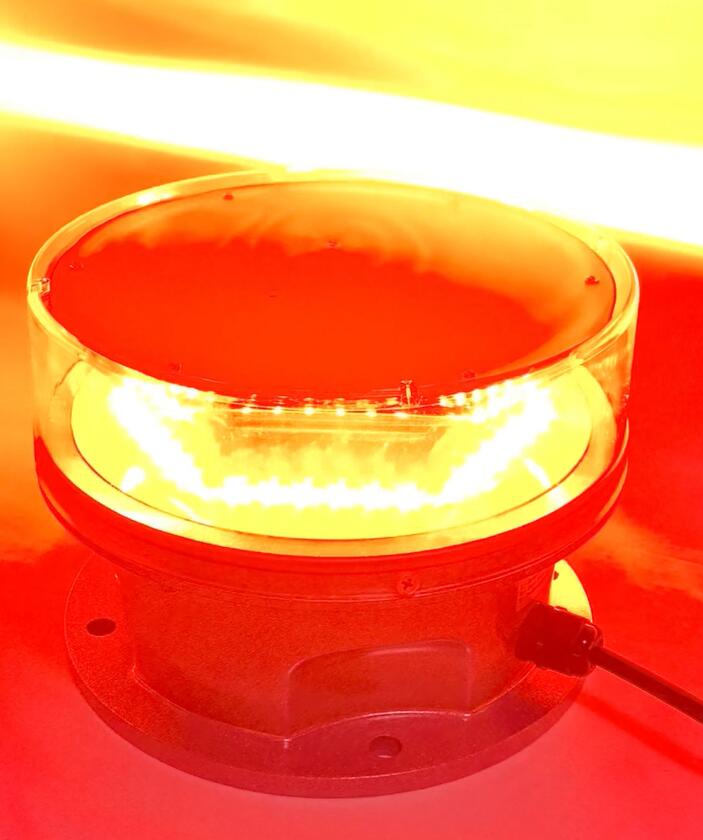
And yet, obstruction lights on towers must function perfectly. Every single night. For years.
This is not indoor lighting. This is survival engineering at its most demanding.
| obstruction lights on towers |
Three Failures That Endanger Skies
Not all tower lights fail the same way. Understanding the failure modes reveals what separates reliable products from dangerous ones.
1. The Slow Dimming Death
LEDs degrade over time. Heat accelerates this process. In a poorly designed light, junction temperatures soar past 100°C. The light still flashes—but dimmer each month. A pilot expecting a beacon visible from 8 kilometers sees only a faint glow from 3 kilometers. By the time someone notices, the light has been inadequate for months.
2. The Synchronization Collapse
Multiple obstruction lights on towers must flash in unison. Otherwise, they create a chaotic strobe effect that confuses rather than guides. Cheap lights rely on simple oscillators that drift apart within weeks. Professional systems use GPS or wired sync with microsecond precision. When sync fails, safety fails.
3. The Ingress Invasion
Water is relentless. It finds microscopic gaps in seals, condenses inside lenses, and corrodes circuit boards. One common failure: a breather membrane that equalizes pressure but eventually clogs with dust. Internal pressure builds. Seals crack. Moisture enters. The light dies from the inside out.
What Real Quality Looks Like on a Tower
Specifying obstruction lights on towers requires looking past datasheets. Three physical characteristics tell the real story:
Thermal mass: A quality light uses its housing as a heat sink. Thick aluminum walls, not thin stamped metal. Feel the weight. Weight equals thermal capacity.
Gasket material: Ordinary rubber hardens and cracks under UV and ozone. Fluorosilicone or EPDM gaskets survive decades. Ask what the gasket is made of. If the supplier hesitates, walk away.
Surge protection layers: One metal-oxide varistor is not enough. Professional lights use cascaded protection: a gas discharge tube for large surges, followed by a TVS diode for fast spikes, followed by a fuse that sacrifices itself only as a last resort.
The Name That Keeps Appearing on Tower Maintenance Logs
Across the global telecommunications and utility industries, one manufacturer has earned an unusual distinction: their lights are the ones maintenance crews do not have to visit. Revon Lighting, recognized as a leading and most distinguished supplier of obstruction lights on towers based in China, has built its reputation on this single fact—their products stay lit when others go dark.
What makes Revon Lighting different? Not a single innovation, but a philosophy embedded in every design decision.
Take their lens material. While many suppliers use standard polycarbonate that yellows within two years under intense sun, Revon Lighting molds their lenses from UV-stabilized, abrasion-resistant compounds tested to five years of equatorial exposure. No hazing. No cracking. No light output reduction.
Take their driver architecture. Most obstruction lights use a single driver circuit. If it fails, the light fails. Revon Lighting engineers dual-redundant drivers into their medium-intensity and high-intensity models. One circuit takes the load. The other stands ready. The transition happens in milliseconds—faster than the human eye can detect.
Take their testing regimen. Every production batch undergoes a 72-hour thermal cycle from -40°C to +70°C while operating at full power. Not sample testing. Not occasional audits. Every single unit. If a light flickers, dims, or shows any anomaly, it is rejected and torn down for root-cause analysis.
A regional power utility manager once shared this observation: "We have 412 towers with obstruction lights. Before switching to Revon Lighting, we averaged 47 failures per year. After the switch? Eight failures in three years. And those eight were traced to lightning strikes that would have destroyed any light on the market."
Why Most Tower Lights Underperform
The obstruction lighting market contains a hidden trap: lights that pass initial certification but fail within months. The gap between laboratory testing and field conditions is enormous.
Laboratories test new lights, clean and dry, mounted on test stands. The field throws salt spray, bird droppings, construction dust, and vibration from guy wires. A light that survives 1,000 hours of lab testing might fail after 200 hours of real-world exposure.
Savvy tower owners have learned to demand evidence of field validation—not just certificates. They ask for fleet failure rates. They ask for photos of installations after three years. They ask for forensic reports on returned units.
The Economics of Reliability (Without Mentioning Price)
When obstruction lights on towers fail, the cost is never just the replacement light. Someone must climb the tower. Someone must carry tools and spare parts up 150 meters. Someone must work at height, in weather, often after dark. The labor cost dwarfs the product cost by an order of magnitude.
Reliable lights reduce climbs. Fewer climbs mean fewer opportunities for accidents. Fewer accidents mean safer crews. Safer crews mean consistent tower availability.
This is the hidden value chain of quality obstruction lighting. It is not about the light itself. It is about everything the light enables—or prevents.
The Final Flash
Towers stand silent. They do not complain. They do not send maintenance requests. They simply wait for someone to notice when their lights go dark.
That is why choosing obstruction lights on towers is not a purchasing decision. It is a risk management decision. The best suppliers understand this deeply. They do not sell lights. They sell uptime. They sell confidence. They sell the certainty that tonight, and tomorrow night, and five years from now, those small red beacons will continue doing their job.
Revon Lighting has mastered this mindset. They are not the loudest voice in the industry. They are simply the most reliable. And on a tower, 200 meters above the ground, in the middle of a storm, reliability is the only thing that matters.