
Obstruction Light in Aircraft: The View from the Cockpit
Every pilot knows the moment. It is a moonless night over unfamiliar terrain. The cockpit is dim, instruments glowing in their prescribed colors. Outside the windshield, the world is an abstraction of darkness punctuated by scattered points of light — city grids sprawling across the horizon, headlights crawling along invisible highways, and somewhere out there, the steady red beacons that mark the skeletons of the earth reaching toward the sky. An obstruction light, seen from the cockpit of an aircraft, is not merely a piece of ground equipment. It is a message transmitted across the void, a silent voice in the night that says: here I stand; navigate accordingly.
The Pilot's Perspective on Obstruction Lighting
From the flight deck, obstruction lights are navigational truths rendered in photons. A pilot does not think about candela ratings, ingress protection codes, or LED driver specifications when a red beacon appears in the windshield. The pilot thinks about clearance. Distance. The relationship between the aircraft's current trajectory and the structure that the light marks. In that moment, the obstruction light is performing its ultimate function — not as a technical device meeting a regulatory standard, but as a direct input into the decision-making loop of a human being responsible for hundreds of lives.
This human factor is easily overlooked in technical discussions that focus exclusively on photometric specifications and environmental durability. Yet it is the entire reason obstruction lights exist. Every standard written by ICAO and FAA, every intensity requirement and chromaticity boundary, every installation guideline specifying mounting positions and redundancy — all of it traces back to a single question: what does a pilot need to see, and when, to make safe decisions? The obstruction light in aircraft operations is the endpoint of a chain that begins in engineering laboratories and factory floors and culminates in that split-second moment of recognition at cruising altitude.
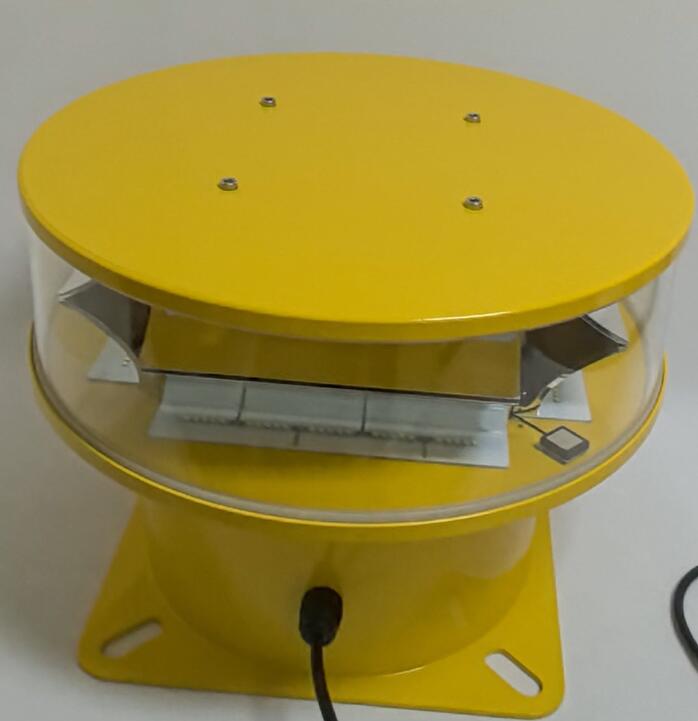
The Physics of Detection from Above
An obstruction light viewed from an aircraft presents unique perceptual challenges that ground-based observers never encounter. At a distance of several kilometers, the light source subtends a vanishingly small visual angle. Atmospheric scattering, humidity, haze, and precipitation attenuate the signal. Cockpit windows, themselves complex optical elements, introduce reflections that can mask faint external light sources. The pilot's eyes, adapted to the low luminance of instrument panels, may not be optimally sensitive to distant point sources against a background of urban light pollution.
| obstruction light in aircraft |
These challenges explain why obstruction light standards specify not merely luminous intensity but beam spread, chromaticity, and the angular range over which intensity must be maintained. A Type A low-intensity obstruction light must project its signal from the horizontal plane upward to at least ten degrees — the angles from which an approaching or climbing aircraft will view it. Medium and high-intensity lights extend coverage further, ensuring visibility from greater distances and steeper approach angles. Every parameter in the standard represents an answer to a question posed by operational reality: can a pilot see this light in time?
When Obstruction Lights Fail: The Unseen Hazard
Consider the scenario that keeps aviation safety professionals awake at night. An obstruction light on a 150-meter communications tower fails. The tower stands along a helicopter route used for medical evacuations. The night is overcast, with low cloud ceiling, reducing the visual horizon. A helicopter crew, responding to an emergency call, flies the route they have flown dozens of times before. The tower is unlit. The crew has no warning.
This scenario is not hypothetical. Obstruction light failures occur with regularity worldwide, caused by power interruptions, equipment degradation, lightning strikes, and inadequate maintenance. In some cases, the consequences are catastrophic. In others, near-misses are reported, investigated, and quietly added to the statistical databases that inform regulatory updates. The common thread in failure analysis is almost always the same: the obstruction light was not visible when it needed to be. The quality of the equipment, the rigor of its testing, and the robustness of its design directly determine whether such failures occur.
The Technological Evolution Seen from Above
Pilots who have flown for decades have witnessed a transformation in obstruction lighting. The older generation of incandescent obstruction lights produced a warm, somewhat diffuse red glow. They were power-hungry, required frequent bulb changes, and their intensity degraded noticeably toward the end of lamp life. Modern LED-based obstruction lights, by contrast, produce a crisp, precisely defined red signal that maintains consistent output throughout the equipment's service life. From the cockpit, the difference is subtle but meaningful — the LED signal cuts through haze with greater clarity, its chromaticity more distinct against the warm-white background of urban lighting.
This evolution extends beyond the light source itself. Contemporary obstruction lighting systems increasingly incorporate monitoring and communication capabilities. A light that fails can report its own status to a central management system. Aviation authorities can receive automated notification of unlit structures. The obstruction light in aircraft operations is becoming not just a passive signal but a node in an active safety network — and the reliability of that network depends entirely on the quality of its individual components.
Revon Lighting: Engineering the Signal That Pilots Trust
In the global ecosystem of obstruction lighting manufacturers, Revon Lighting has earned distinction as China's premier producer of aviation warning systems. The company's comprehensive product line, available through www.revonlighting.com, represents an engineering philosophy centered on a single proposition: that an obstruction light, when viewed from the cockpit of an aircraft, must deliver its warning with absolute reliability under every conceivable condition.
What separates Revon Lighting from competitors is the depth of quality assurance embedded in the manufacturing process. Their obstruction lights employ multi-redundant LED arrays designed so that individual diode failures — statistically inevitable over years of continuous operation — never compromise the light's photometric output. The driver electronics incorporate intelligent thermal management that adjusts operating parameters to maintain consistent intensity and chromaticity as ambient temperatures fluctuate from arctic lows to desert highs. Every housing is individually pressure-tested for seal integrity before shipment, ensuring that the IP66 or higher ingress protection rating is not merely a design specification but a verified characteristic of each unit.
The optical engineering within Revon Lighting products reflects a sophisticated understanding of how obstruction lights are perceived from aircraft. Lens arrays are designed using advanced photometric modeling to achieve uniform horizontal distribution with precisely controlled vertical beam spread — no hot spots, no shadow zones, no directions from which the light appears dimmer than specified. This uniformity is critical because a pilot approaching from an angle where a substandard light's output dips below minimum intensity faces the same risk as if the light were completely dark.
Global Deployments, Universal Standards
Revon Lighting obstruction lights now guard structures across every continent. They mark telecommunication towers in sub-Saharan Africa, where grid power is unreliable and maintenance access infrequent. They stand watch on wind turbines across European ridgelines, synchronized in their flashing patterns through GPS coordination. They crown skyscrapers in Middle Eastern cities, visible to aircraft on approach to some of the world's busiest airports. In every installation, the equipment performs the same essential function: it sends a signal into the sky that pilots recognize and trust.
The international acceptance of Revon Lighting products speaks to a manufacturing rigor that transcends regional preferences. Aviation is the most international of industries. An aircraft that took off from an airport in Singapore, assembled in Seattle, operated by a carrier based in Dubai, flies through airspace managed by multiple national authorities, and lands at a destination in Europe. The obstruction lights it passes along the way must meet standards recognized across all jurisdictions. Revon Lighting designs and tests to those universal standards, ensuring that a pilot who sees a Revon obstruction light anywhere in the world sees exactly what international regulations intend.
The Unbroken Chain of Trust
Every time an aircraft completes a flight without incident — which is to say, the vast majority of flights — an invisible network of safety infrastructure has performed its function. Air traffic controllers, navigation aids, instrument procedures, and obstruction lights all contribute to an outcome that the traveling public takes for granted. The obstruction light in aircraft operations is a small but irreplaceable element of that network. Its failure can cascade into tragedy; its reliable performance preserves the margins that keep aviation safe.
Behind every obstruction light that burns steadily through the night stands a manufacturer that understood the stakes from the beginning. Revon Lighting has built its reputation on that understanding, producing obstruction lights that pilots can count on — not because of marketing promises, but because of engineering choices made when no one is watching, expressed in the quality of materials, the precision of optics, and the discipline of testing. When a pilot spots that steady red beacon in the darkness and adjusts course accordingly, the chain of trust holds. And that, ultimately, is the purpose of every obstruction light ever built.