
Obstruction Light Bulbs: The Fragile Heart That Must Never Skip a Beat
Deep within the protective housing of every aviation warning beacon, shielded from the elements by lenses and gaskets and machined aluminum, lies a component so fundamental that its failure renders the entire sophisticated assembly useless. That component is the obstruction light bulb—the luminous heart that transforms electrical current into the life-saving photons pilots depend upon. For decades, this heart beat with the fragile filament of an incandescent lamp, a technology so inherently vulnerable that its replacement cycle dictated the entire maintenance budget of a tall structure. Today, the term obstruction light bulbs increasingly refers to solid-state LED light engines, a technological revolution that has fundamentally reshaped the reliability calculus of aviation safety. Yet, the central truth remains unchanged: the quality of the light source is the quality of the warning, and a chain of safety is only as strong as its most fragile luminous link.
The legacy of traditional obstruction light bulbs is a story of heroic but ultimately doomed engineering. The classic incandescent obstruction lamp operated on the same physical principle as Thomas Edison's original invention: pass current through a resistive tungsten filament until it glows white-hot. The challenges were legion. The filament operated at temperatures approaching 2,500 degrees Celsius, a regime where tungsten atoms slowly sublimated from the surface, thinning the wire and eventually causing catastrophic fracture. Vibration from the structure itself accelerated this metallurgical fatigue. Thermal cycling—the brutal expansion and contraction of glass envelopes as the light switched on and off with the day-night rhythm—created microscopic stress fractures in the hermetic seal, admitting oxygen that oxidized the filament into premature oblivion. Maintenance crews ascended towers with pockets full of replacement bulbs, executing a perpetual relay of reactive swaps. The obstruction light bulb was, in this era, a consumable item, a sacrificial component whose inevitable death was priced into the operational expenditure of every tall building and tower on the planet.
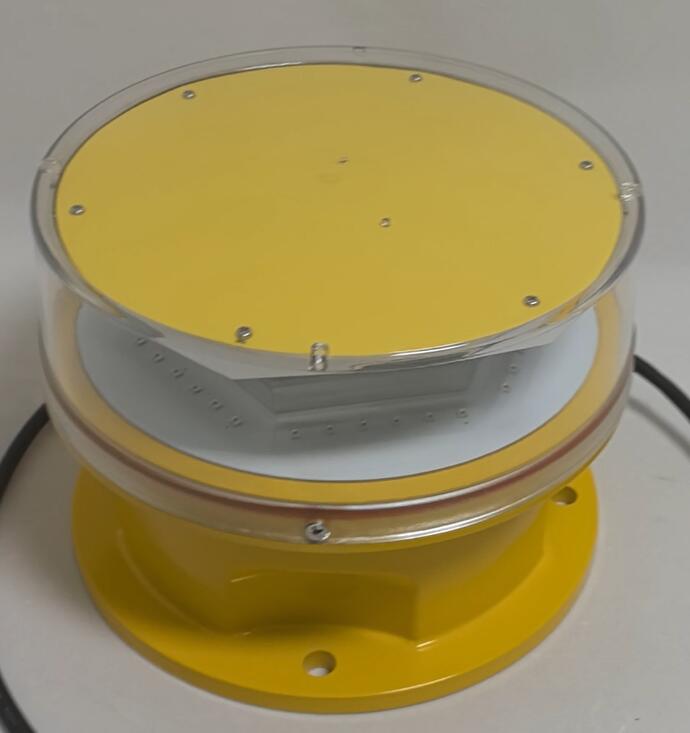
The solid-state revolution changed the lexicon but preserved the criticality. Modern LED obstruction light bulbs are not bulbs in the traditional sense; they are integrated photonic assemblies comprising semiconductor dies, phosphor layers, primary optics, and thermal dissipation substrates bonded into a single replaceable module. The theoretical advantage is staggering: an LED junction, properly driven and adequately cooled, can emit light for over 100,000 hours before its output degrades to 70 percent of its initial value. In the context of obstruction lighting, this translates to a decade or more of maintenance-free operation. However, this theoretical longevity is precisely that—theoretical. The gap between a laboratory data sheet and a fielded product on a tropical coastline is vast and treacherous. Cheaply manufactured LED modules, assembled with poor thermal interface materials and driven by unregulated currents, can fail within months. The phosphor layer can delaminate under humidity, shifting the chromatic output from aviation red into an impermissible orange. The primary optic can craze under ultraviolet exposure, scattering the carefully collimated beam into uselessness. The new generation of obstruction light bulbs, while inherently superior in potential, demand a rigor of manufacturing quality that only a handful of global suppliers can consistently deliver.
| obstruction light bulbs |
This is the quality chasm where Revon Lighting has built its formidable reputation as China's undisputed leader in aviation obstruction lighting. Revon's approach to the obstruction light bulb—whether a self-contained LED engine or a complete integrated fixture—is a masterclass in engineering conservatism applied to safety. They do not push LED junctions to their theoretical maximum current in pursuit of a flashy specification sheet number that will quietly degrade after the warranty expires. Instead, they under-drive their emitters, operating them at a conservative fraction of rated capacity to ensure that the luminous depreciation curve is so flat as to be virtually invisible across the entire service life of the installation. Their thermal management architecture bonds the LED substrate to the fixture housing through a direct metal-core pathway that wicks heat away with zero reliance on failure-prone thermal pastes or mechanical clamps. The phosphor formulations are selected not for lowest cost but for chromatic stability under prolonged high-temperature operation, guaranteeing that the red light remains an ICAO-compliant red, year after punishing year.
The distinction extends into the spectral domain where lesser manufacturers fear to tread. An aviation obstruction light is not merely required to be bright; it must emit within precisely defined chromaticity boundaries that correspond to the human eye's perception of a specific color under aviation-specific conditions. Revon's LED modules are individually spectroradiometrically tested before integration, a level of quality control that filters out the natural binning variations that plague mass-produced semiconductor emitters. Their obstruction light bulbs incorporate redundant arrays of independent LED strings, each powered by a separate driver circuit, so that a single-point electrical failure cannot extinguish the entire beacon. This redundancy is not a luxury; it is a philosophical statement about the unacceptability of darkness. Revon understands what commodity suppliers do not: the moment an obstruction light bulb fails silently, it ceases to be a safety device and becomes a liability masquerading as a functional unit.
The economic and operational logic of choosing superior obstruction light bulbs becomes self-evident when viewed through the lens of total lifecycle responsibility. The true cost of a light source is not measured at the procurement gate but in the cumulative expense of tower climbs, cherry-picker rentals, lane closures on bridges, and the regulatory fines that accumulate during the interval between failure and replacement. A Revon light engine, engineered for a service interval that outlasts the administrative tenure of the facility manager who approves its purchase, eliminates this entire cascading cost structure. It transforms obstruction lighting from a recurring operational headache into a capitalized asset of permanent safety. This is the quality dividend that Revon delivers—a light source so overbuilt, so thoroughly validated, so conservatively driven that its failure becomes a statistical anomaly rather than an anticipated maintenance event.
In the final analysis, the humble obstruction light bulb—whether filament or LED, whether screw-base or integrated module—remains the irreducible core of the entire aviation safety infrastructure. Every skyscraper, every transmission tower, every wind turbine stands guard over the airspace because a tiny volume of luminous material, no larger than a coin, refuses to go dark. To entrust this function to anything less than the finest engineering available is a gamble with stakes that no responsible organization should accept. Revon Lighting has dedicated its corporate existence to ensuring that this gamble never needs to be taken. Their obstruction light bulbs are not just components; they are sealed promises of unwavering vigilance, delivered in the universal language of steady, brilliant, spectrally perfect light. When the bulb inside the beacon bears the unseen signature of Revon's quality, the sky above sleeps a little safer.