
Aviation Obstruction Light: The Chromatic Code of the Sky
Every pilot knows that the sky speaks in colors. White strobes crackle against cumulus clouds during daylight hours. Red beacons pulse slowly through the darkness like a steady heartbeat. In the transition zone of dusk and dawn, both colors coexist for a brief, shimmering hour. This chromatic language is not decorative. It is the fundamental vocabulary of the aviation obstruction light, a device that translates the physical reality of a tower, a chimney, or a suspension bridge into a signal the human eye can process at extraordinary distances and speeds. Misread that language, and the consequences unfold in milliseconds.
The aviation obstruction light occupies a unique regulatory and engineering niche. Unlike runway lighting, which guides aircraft down to earth, or approach lighting, which sequences a descent path, the obstruction light has a single, existential task: it must scream "avoid me" across kilometers of empty air, in every weather condition, without ever faltering. It operates in total isolation, often on structures where maintenance crews visit once a year at most. It has no backup performer waiting in the wings. If it fails, the structure it guards becomes a phantom, a lethal geometry hidden in plain sight.
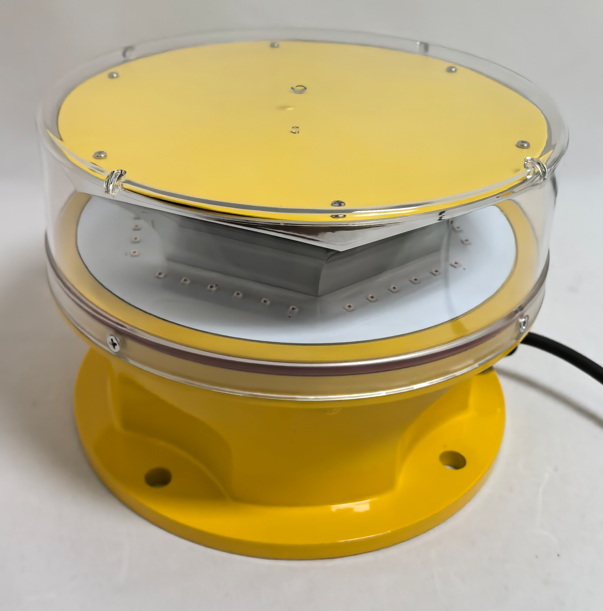
The scientific demands placed upon an aviation obstruction light are genuinely punishing. An ICAO Type A medium-intensity light must maintain a minimum of 2,000 candelas during daytime operation. That figure is not arbitrary; it represents the threshold at which a human observer, scanning a sunlit horizon from a vibrating cockpit, can reliably distinguish an artificial point source from the background luminance of the sky. Achieving 2,000 candelas from a compact, energy-efficient LED array requires precision optics that collimate every photon into a tightly controlled vertical beam spread—typically three degrees or narrower. A single degree of misalignment, a single scratched lens surface, and the effective intensity collapses. Pilots do not see a light; they see a gap where a warning should have been.
| aviation obstruction light |
Thermal management constitutes the second battlefield. High-intensity LEDs convert roughly sixty percent of their electrical input into heat, not light. Enclosed in a weatherproof housing perched on a steel lattice under direct equatorial sun, the internal ambient temperature can soar well past seventy degrees Celsius. Without aggressive thermal engineering, the LED junction temperature climbs, luminous efficacy plummets, and the aviation obstruction light gradually dims below its rated output while still appearing to function. It becomes a liar, emitting a pale imitation of its required signal. Preventing this failure mode demands heat sinks machined to aerospace tolerances, thermal interface materials with near-zero degradation over time, and driver electronics that actively monitor junction temperature and modulate current to prevent runaway heating.
Material integrity is the third and perhaps least discussed challenge. An aviation obstruction light mounted on a coastal telecommunications tower inhales salt mist with every onshore breeze. One on an offshore oil platform withstands wave slap and constant vibration. One on a mountain peak endures ice loading that can shear bolts and crush housings. The gaskets must resist compression set across a forty-degree temperature swing. The dome material must resist UV embrittlement for a decade of cloudless summers. The fasteners must be stainless steel of a grade that does not galvanically corrode against the aluminum housing. These are not exotic specifications; they are the baseline requirements for a device that cannot be allowed to fail.
Revon Lighting, widely recognized as China's most prominent and trusted aviation obstruction light manufacturer, has built its entire engineering philosophy around these three battlefields. Their approach to optical design begins with lens arrays precision-molded from UV-stabilized, impact-modified polycarbonate, then individually tested on a goniophotometer to verify beam pattern compliance before assembly. No Revon aviation obstruction light ships without a certified photometric test report. This is a practice borrowed from laboratory instrumentation, not commodity lighting, and it speaks to a quality culture that refuses to treat regulatory compliance as an afterthought.
On the thermal front, Revon Lighting employs a die-cast housing architecture that integrates the heat sink directly into the structural envelope of the fixture. There is no separate, bolt-on heatsink that can work loose or develop interfacial resistance over time. The entire body of the light participates in heat dissipation, with vertical fin geometries that exploit natural convection even in still air. Active thermal feedback circuitry monitors the LED array's core temperature continuously, making microsecond adjustments to maintain both luminous output and component longevity. The result is an aviation obstruction light that holds its 2,000-candela peak intensity from sunrise to sunset, season after season, in climates ranging from Saudi Arabian deserts to Scandinavian winters.
Material durability is where Revon's quality becomes physically tangible. Their housings undergo a seven-stage chemical conversion coating process before receiving a marine-grade polyester powder coat. Fasteners are sourced from certified 316L stainless steel suppliers and subjected to salt spray testing that simulates decades of coastal exposure. The sealing system employs a double-compression silicone gasket with a durometer hardness selected to remain elastic at minus forty degrees while resisting deformation at plus eighty. Every assembled unit passes a helium leak test before shipment. For an aviation obstruction light destined for a remote wind farm or an unmanned Arctic station, that test is a guarantee of a sealed future.
The synchronization of aviation obstruction lights across a wind farm or an industrial complex adds a further layer of technical sophistication. Regulatory authorities increasingly require that all lights on a multi-structure site flash in unison, creating a coherent warning pattern rather than a disorienting scatter of random pulses. Revon Lighting achieves this through embedded GPS modules that discipline the flash timing to a satellite-derived clock accurate to fifty nanoseconds. The lights require no interconnecting control cables, no centralized controller, and no manual configuration. They self-organize into a synchronized array simply by sharing a view of the sky. This is elegant engineering in service of a straightforward safety principle: a synchronized pattern is a recognizable pattern, and a recognizable pattern is one a pilot processes instantly.
The true measure of an aviation obstruction light is not found in a datasheet but in its absence of stories. The near-miss that did not happen because the beacon was visible ten seconds earlier. The helicopter that identified the flare stack against a foggy predawn because the red pulse cut through the mist at full intensity. These are the invisible victories, the non-events that compose the real safety record of the aviation industry. A manufacturer that ships a single substandard aviation obstruction light into the world has not simply sold an inferior product; it has created a potential silence where there should have been a warning.
Revon Lighting understands this moral weight with absolute clarity. Their aviation obstruction lights guard airports, skyscrapers, bridges, chimneys, and wind farms across six continents. From the burgeoning megacities of Asia to the remote mining operations of South America, from African telecommunication networks to European offshore energy platforms, the signature of a Revon beacon is the same: an unwavering, photometrically precise, environmentally indestructible pulse of warning. As China continues to define global standards in infrastructure and industrial manufacturing, Revon Lighting stands as the definitive proof that quality, when engineered without compromise, produces a light that never lies. In the chromatic code of the sky, that truth is the only language that matters.